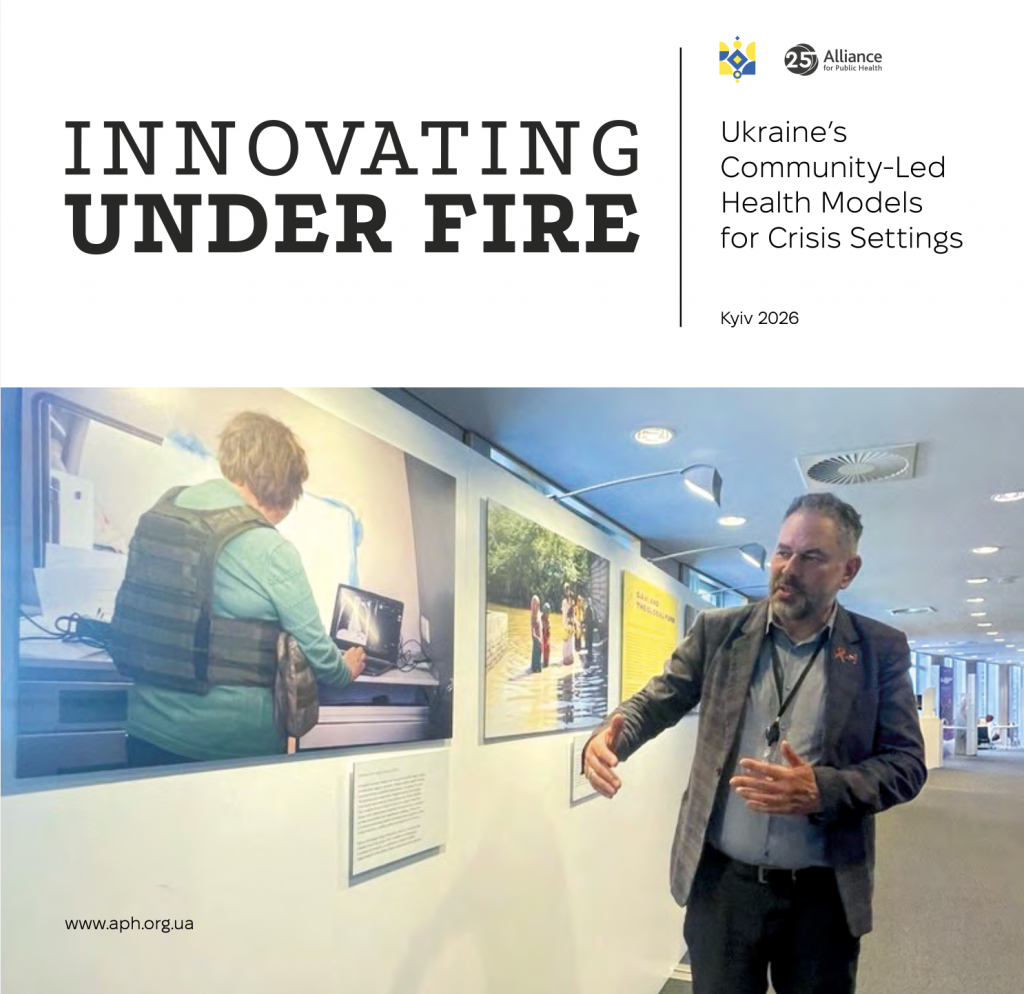
At a time when Ukraine continues to face attacks on its health infrastructure, the country’s experience in maintaining essential health services during wartime is becoming a source of practical lessons for the global public health community.
Ahead of the 25th International AIDS Conference (AIDS 2026), taking place 25–31 July in Rio de Janeiro, Brazil, the Alliance for Public Health will present its new publication, Innovating Under Fire: Ukraine’s Community-Led Health Models for Crisis Settings. The publication brings together Ukraine’s practical experience in adapting public health programmes during the full-scale war—experience that can inform countries responding to armed conflicts, humanitarian crises, and other complex emergencies.
Over more than four years of full-scale war, Ukrainian civil society organizations and the national health system have not only maintained continuity of essential services for people living with HIV, tuberculosis, and viral hepatitis, but have also developed innovative models of healthcare and social service delivery. These experiences form the foundation of the publication, which presents nine practical case studies accompanied by recommendations for adaptation in other settings.
The publication showcases proven approaches developed and implemented in Ukraine, including:
- adapting HIV prevention, testing, and treatment services in both frontline and lower-conflict regions;
- mobile healthcare teams serving communities near the frontline;
- community-based support models for internally displaced people and Ukrainian refugees;
- digital platforms for HIV prevention, telehealth, and mental health services;
- the introduction of long-acting medicines to ensure continuity of treatment;
- innovative approaches to mental health care and rehabilitation for veterans and war-affected civilians.
A central message of the publication is that Ukraine’s experience offers valuable lessons for the global public health community. Flexibility, rapid response, integration of healthcare and humanitarian assistance, digital innovation, and strong partnerships between government institutions and civil society have enabled the development of service delivery models that can strengthen health system resilience in crisis settings.
During the full-scale war, programmes implemented by the Alliance for Public Health and its partners identified one in every two newly diagnosed HIV cases in Ukraine. At the same time, programme teams ensured uninterrupted prevention, testing, and treatment services despite mass displacement, destruction of healthcare infrastructure, and continued attacks on the health system.
The publication will be officially presented at the joint Ukrainian booth Ukraine’s Community Resilience: Global Lessons in the Global Village at AIDS 2026. It will form part of a broader presentation of Ukraine’s experience in community-led health services, digital innovation, mobile healthcare, and models for ensuring continuity of care during wartime—demonstrating how solutions developed in Ukraine can help strengthen health system resilience in other countries facing humanitarian crises.
Innovating Under Fire (download .pdf file)