
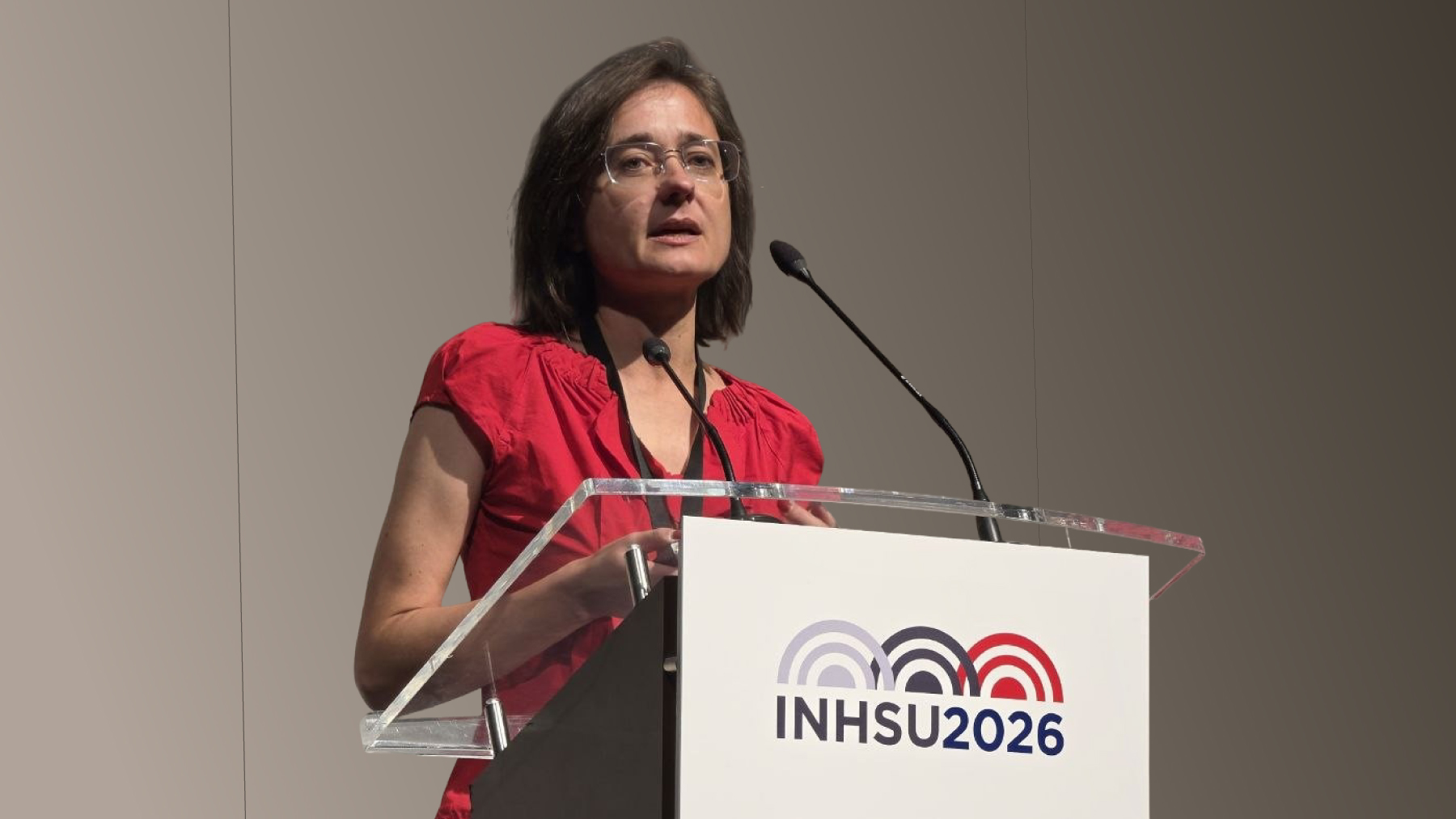
On the opening morning of INHSU 2026’s main programme, Alliance for Public Health’s Dr Tetiana Deshko delivered a plenary presentation connecting the audience in Prague with colleagues working in Ukraine. She shared how services have adapted through war and how that experience is informing care in other countries.
As Dr Deshko spoke on the plenary stage at INHSU 2026 in Prague, an Alliance for Public Health mobile team was delivering services in Ukraine. A live connection brought the audience to Cherkasy region, where a colleague stood beside a mobile clinic and showed how the team provides HIV testing in the PWID community.
The connection made the subject of Tetiana’s presentation immediate. The work she was describing was continuing as delegates watched.
In her plenary presentation on 7 October, APH’s Director of International Programs explored how harm reduction and infectious disease services adapt to war and displacement, and how experience from Ukraine is informing programmes in other countries. Her presentation, “Adapting Harm Reduction and Infectious Disease Models of Care in Conflict Settings”, brought together evidence, practical solutions and the voices of people working through the crisis.
Adapting services as people’s lives change
One image showed the scale of the challenge: a warehouse destroyed by a russian missile attack in July 2026. It held around 30 million syringes intended for Ukraine’s harm reduction programmes in 2027. Another showed a damaged mobile clinic.
These attacks threaten the supplies and infrastructure on which services depend. Displacement creates further challenges, separating people from their doctors, treatment sites and support networks.
“We were expecting the worst to happen in the face of HIV and hepatitis C epidemics in Ukraine as war broke out,” Dr Deshko told the conference. “But it did not.”
She described how teams adapted services to keep people connected to care: mobile clinics reached communities with limited access, take-home medication helped people continue opioid agonist treatment, and coordination between providers supported those forced to move.
“War made us adapt and change,” Dr Deshko said.
Some services expanded even as the war forced others to close. Figures presented by Tetiana Deshko showed that Ukraine’s public opioid agonist treatment sites increased and were supporting more than 20,000 patients by the end of 2025. Since the start of the full-scale invasion, more sites had opened.
These approaches build on APH’s more than 25 years of public health experience and its relationships with community organisations and healthcare providers. During the war, APH and its partners have provided critical support to 2.2 million people across Ukraine.
Making innovation useful in everyday life
The presentation showed how new approaches can address immediate barriers to care.
Long-acting treatment can reduce the need for frequent visits when travel is difficult or unsafe. Online consultations and postal delivery help maintain access when people move. Integrating mental health support into trusted community services can reach people who face barriers elsewhere.
APH’s TWIIN digital assistant offers health information and helps people find services around the clock. Dr Deshko described its relevance to someone in a bomb shelter or travelling to another location when a doctor is unavailable.
The same attention to people’s circumstances shapes APH’s work with young people. Through accessible information, online outreach and harm reduction support, programmes maintain contact with communities whose needs are changing during the war.
“These are the groups who will be rebuilding our country when the war is over,” Dr Deshko said.
She also recognised the work of Club Eney, a women-led community organisation supporting women who have experienced conflict-related sexual violence. Tetiana described how sustained contact and psychosocial support help women access care and regain dignity, showing why responses during war must address trauma alongside HIV, hepatitis and drug use.
Experience that travels beyond Ukraine
The presentation demonstrated APH’s role as an international public health organisation rooted in Ukraine.
Ukrainian specialists have shared experience of long-acting buprenorphine treatment with colleagues in Kyrgyzstan and Egypt, supporting the adaptation of services to local needs. APH’s work on community-based hepatitis C care includes training colleagues from Egypt, Kyrgyzstan and Nigeria, with continued clinical mentoring for teams in Kyrgyzstan and Nigeria.
This collaboration takes learning from Ukraine into service delivery and research in other countries. Dr Deshko also acknowledged the experience of Czech colleagues that helped inform APH’s pilot integrating ADHD treatment into services for people who use stimulants.
The presentation placed these examples alongside experiences from other conflict settings, including Manipur in India and Myanmar. Across different contexts, it highlighted the importance of flexible services, trusted community networks and care that can follow people when their circumstances change.
A message from a colleague who could not be in the room
Towards the end of her presentation, Dr Deshko introduced Oleg Dymaretsky, a leader of the Ukrainian Network of People Who Use Drugs (VOLNA). He could not join the conference in Prague. A serving member of Ukraine’s armed forces, he addressed delegates in a recorded message.
His appeal was for productive work, lasting solutions and meaningful commitments to support people. The audience responded with applause, with some delegates standing.
Dymaretsky’s message brought another dimension of community leadership into the room. People who use drugs help shape services, organise support and represent their communities. Some, like Dymaretsky, are also serving in Ukraine’s armed forces. Their experience and leadership must remain part of the international conversation about health during war.
APH and its partners are continuing these conversations throughout INHSU 2026, with contributions on responses to conflict and displacement, community-based hepatitis C care, long-acting treatment and the integration of mental health support into harm reduction services.
APH welcomes opportunities to work with communities, researchers, healthcare providers and international partners to adapt these approaches, strengthen the evidence behind them and bring essential services to more people.