“We have to be persistent. We are fighting for life.”
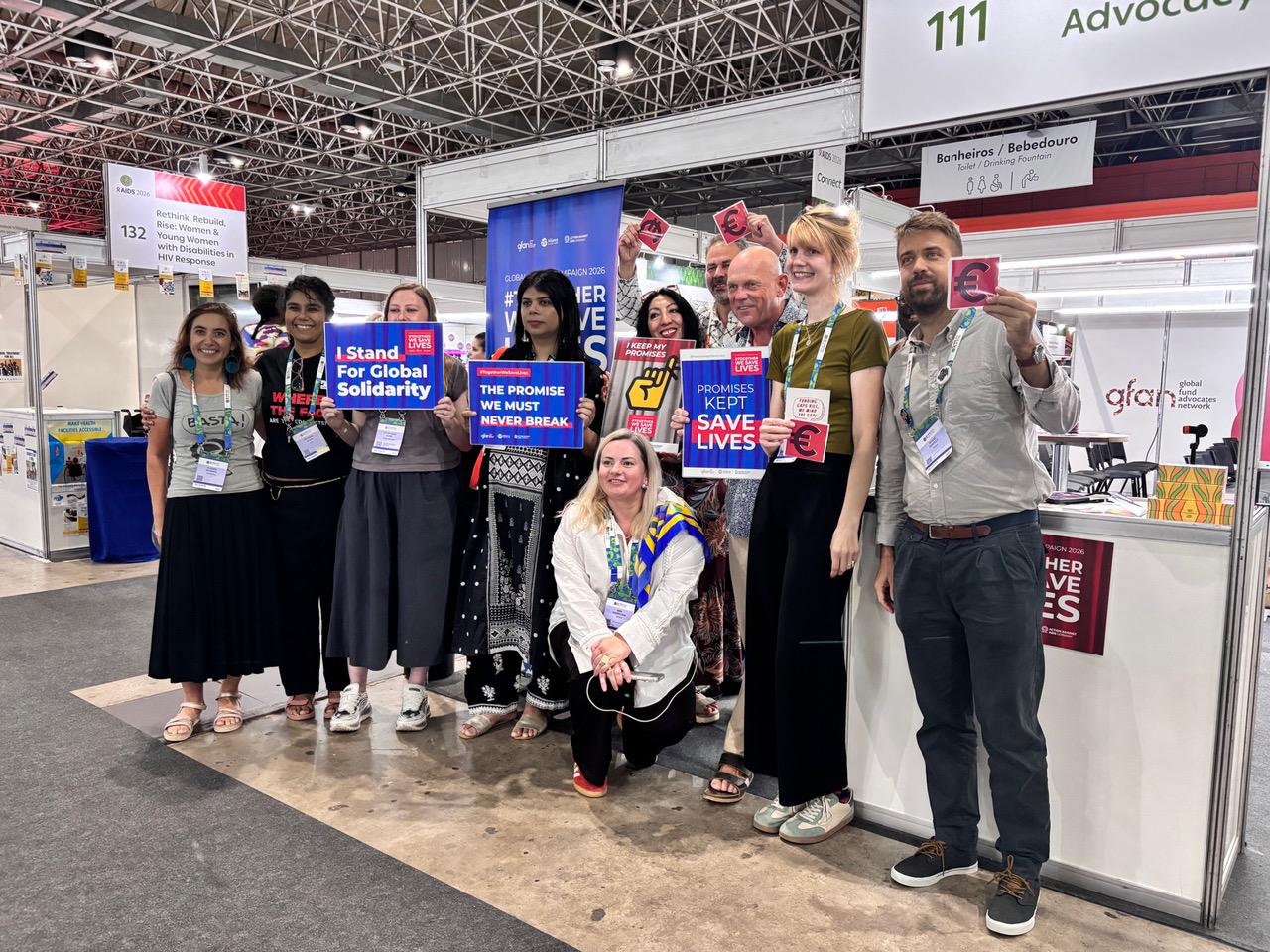
At the GFAN booth following the campaign preview and launch event at AIDS 2026. Photo: Alliance for Public Health (APH) .
This blog is part of Together We Save Lives – The Global Fund: From Financial Contributions to Impact, a joint campaign by the Global Fund Advocates Network (GFAN), Alliance for Public Health (APH) and Action against AIDS Germany. The campaign follows the journey from financial commitments to their real impact on people and communities, asking what global solidarity means in practice and why promises only save lives when they are kept.
A financial pledge can make headlines. But what happens after a government announces a contribution? When does that promise actually begin to make a difference in people’s lives?
This is where Together We Save Lives – The Global Fund: From Financial Contributions to Impact starts. Over the coming months, the Global Fund Advocates Network (GFAN), Alliance for Public Health (APH) and Action against AIDS Germany will publish three campaign videos alongside blogs, interviews and contributions from communities and advocates around the world.
.We started the conversation in Rio.
We got a first glimpse of this conversation at AIDS 2026 in Rio de Janeiro. When we previewed the campaign and showed the first video, we asked activists and advocates from different countries a simple question: .What does global solidarity mean to you?
The answers made clear that global solidarity is more than an abstract principle, it is rooted in mutual support, shared responsibility and action.
For Andriy Klepikov of Alliance for Public Health, it begins with something very human:
“Global solidarity is mutual support, shared experience, compassion and care.”
Courtney Howe of STOPAIDS connected solidarity to what has already been achieved through collaboration and cooperation, including progress on human rights and equality. But she also pointed to a challenge that has become increasingly familiar in donor countries: international commitments are being pitted against domestic priorities. For advocates, she said, this means challenging:
“this false narrative that it’s either domestic or it’s global, that we can’t do both”
Gracia Violetta Ross Quiroga of the World Council of Churches framed solidarity as both care and responsibility:
“It’s loving your neighbor as yourself. But it’s also a commitment and obligation”
And Saro Imran, transgender activist and GFAN speaker from Pakistan, brought in the perspective of communities whose access to basic services and rights cannot be taken for granted, a reminder that solidarity ultimately has to reach those who are too often pushed to the margins. These perspectives bring us back to the question at the heart of our first campaign video: What does a promise actually make possible?
A promise has to become something people can rely on.
A government announces a contribution to the Global Fund. It is a political commitment, a figure in a budget, a promise made publicly. But the promise still has a long way to go. When funding is delivered, a government’s commitment can become uninterrupted HIV treatment, rapid TB diagnostics, malaria prevention or community systems reaching people who are often left behind. As the first video puts it:
“All that work, it starts with a promise. But a promise alone is not enough”
The experiences shared in Rio brought this into sharp focus. Anton Basenko of the International Network of People who Use Drugs (INPUD) spoke from the reality of Ukraine, where war puts enormous pressure on public resources while people continue to depend on HIV prevention, treatment and other essential services. When resources are stretched to their limits, maintaining these services becomes a question of what can be sustained, and who can continue to access it.
Andriy Klepikov made this even more tangible. Only days before the discussion in Rio, he told us, a Russian missile had destroyed a warehouse in Ukraine containing prevention commodities procured with Global Fund support. Yet services continued.
“It’s so critical to show how we are interdependent on Global Fund financing, on global solidarity in this situation”
This is what stands behind the headlines and funding announcements: a warehouse can be destroyed overnight, but people still wake up the next morning needing their medication, and communities still have people to reach and services to keep running. .Solidarity is knowing that you will not be left alone when that happens, that promises will be kept and the support you depend on will still be there.
But that trust depends on promises being kept. What happens when they are not?
Commitments can look firm when they are announced. But governments change, budgets are revised and political priorities shift. Funding can be delayed, reduced or questioned, while the people and communities relying on it still need to plan, provide services and continue their work. So, solidarity also requires accountability. When our conversation in Rio turned to what advocates do when governments fail to live up to their commitments, Andriy Klepikov put it plainly:
“We have to be persistent. We are fighting for life”
And sometimes persistence also means changing course, finding new ways to convince, advocate and keep going when the usual ones no longer work. That persistence can take many forms: reminding political decision-makers of the commitments they have made, as Courtney Howe stressed, but also being willing to challenge power and our understanding of where power lies, as Gracia Violetta Ross Quiroga put it, communities are never powerless, even when funding disappears and political support fades. There are things no budget cut and no political decision can take away:
“Hope, commitment, agency, empowerment, leadership, knowledge. These are the things we already have in our hands”
That may be one of the most important reminders as we begin this campaign. Communities are not waiting. Communities are already organizing, caring, advocating and keeping services going. .What they need is to be able to trust that others will do their part too
And that brings us back to where we started: the promise. A pledge matters because people and communities need to be able to build on it, plan with it and trust that it will still be there when circumstances become difficult. Over the coming months, Together We Save Lives will keep following that promise: what it makes possible when it is kept, what happens when it is not, and what it takes to turn financial commitments into lasting impact.
Because a promise is only the beginning.
Peter Wiessner, Johanna Fipp, Priyanka Aiyer, Inna Gavrylova.
Read the blog:
Alliance for Public Health: https://aph.org.ua/en/news/a-promise-alone-is-not-enough-2/
Action against AIDS Germany: https://www.aids-kampagne.de/aktuelles/2026-09-01-promise-alone-not-enough