
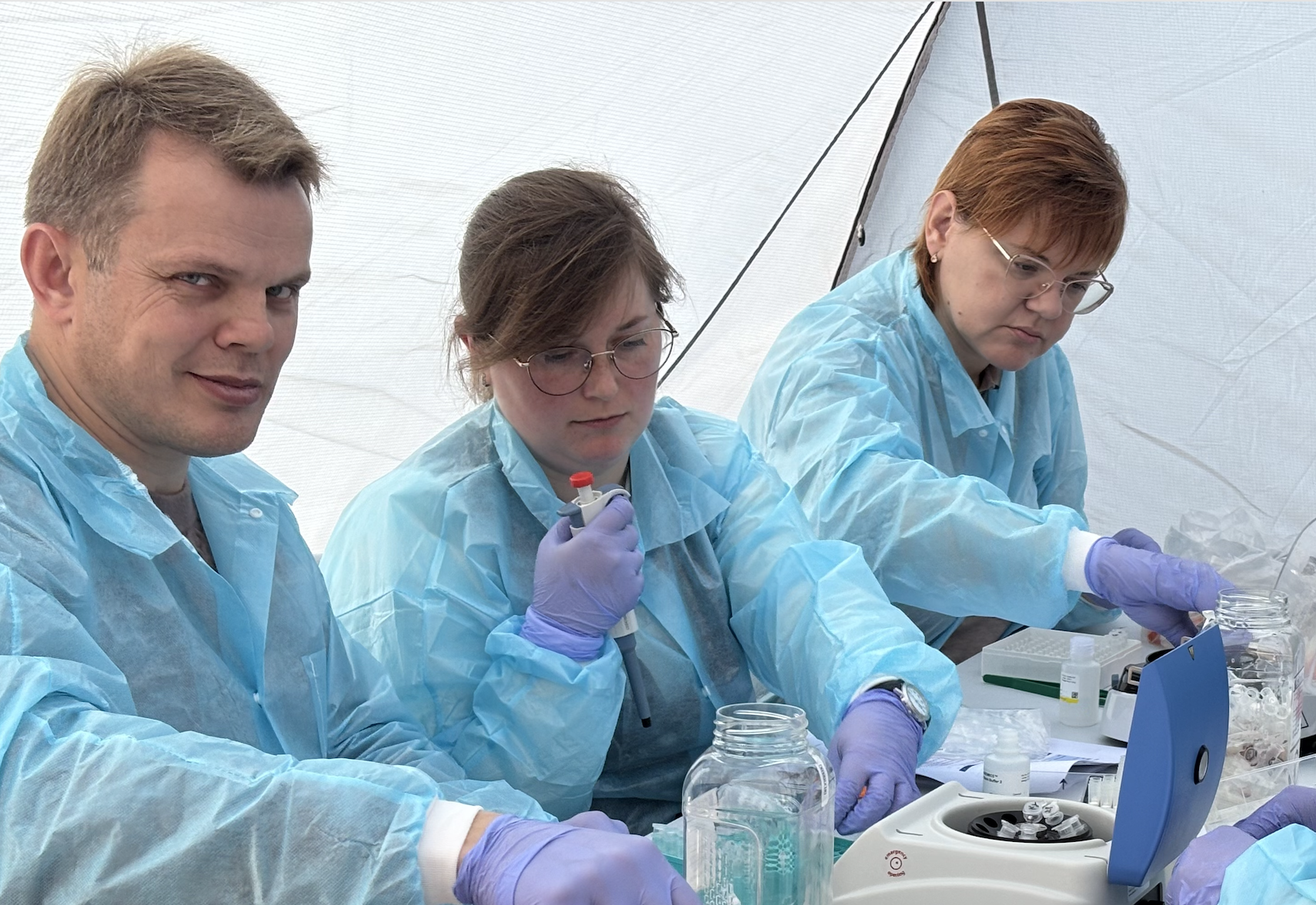
On 19–23 October 2026, the International Charitable Foundation Alliance for Public Health (APH), with support from the Swedish International Development Cooperation Agency (Sida), held a five-day practical training course in nanopore sequencing using Oxford Nanopore Technologies in a mobile laboratory. The training took place with the participation of the L. V. Gromashevsky Institute of Epidemiology and Infectious Diseases of the National Academy of Medical Sciences of Ukraine and Kharkiv National Medical University.
The course equipped Ukrainian specialists with practical skills in a method that, until recently, had been available only in major reference laboratories: identifying pathogens associated with wound infections and antibiotic resistance genes directly from clinical samples, without relying on a permanent laboratory facility.
Antimicrobial resistance (AMR) is one of the most serious threats to the treatment of wound infections, and war is making it worse. Large numbers of traumatic injuries, prolonged evacuation times and transfers between healthcare facilities contribute to the spread of multidrug-resistant bacteria. European hospitals treating Ukrainian patients are detecting the same strains, making AMR in Ukraine a shared health security concern across the continent. Conventional bacteriological diagnosis requires several days of culture, while sequencing can reveal both the pathogens present in a wound and the resistance genes they carry.
Pavlo Smyrnov, Deputy Executive Director of the Alliance for Public Health, said: “APH has long worked where health systems are most vulnerable. For us, it is essential that Ukrainian teams retain the capacity to generate scientific evidence for epidemiological surveillance – and that they can do so in the conditions they face every day.”
From Swab to Result
The programme covered the full workflow: preparing wound samples, extracting DNA, sequencing and conducting bioinformatic analysis on a laptop. Participants learned to identify pathogens using the 16S rRNA gene, type hospital-associated pathogens and detect genes encoding carbapenemases – enzymes that break down last-resort antibiotics.
Practical sessions also addressed contamination prevention, biosafety in mobile settings, patient data protection and accurate interpretation of results. The training was research-focused: detecting a resistance gene alone does not establish which antibiotic will be effective, and the results are not intended to guide treatment decisions.
Experience in Outbreak Response
The course was led by Dr Luke Meredith of Deploy Laboratory Solutions, Dublin, Ireland, a specialist in field sequencing and mobile laboratory deployment. In 2015, he took part in the Ebola outbreak response in Sierra Leone, where he led an on-site sequencing service. He also worked as a research associate in the Department of Pathology at the University of Cambridge and co-authored a study tracking SARS-CoV-2 variants in Ukraine in 2021 using nanopore sequencing, and served as the lead consultant on development of genomic surveillance strategies for the Eastern Mediterranean region for WHO.
Dr Luke Meredith said: “Our experience in outbreak responses and capacity development in Sierra Leone and across Africa and the Eastern Mediterranean over the past decade has shown that the closer we can bring laboratory capabilities to where they are needed, the sooner we can understand what we are dealing with. The Ukrainian team is working under some of the most challenging conditions imaginable, and over these five days they have demonstrated their ability to carry out the complete genomic analysis workflow in a mobile laboratory. This provides a strong foundation for them to further develop, adapt and independently apply these techniques to Ukraine’s research and public health needs, both in established laboratories and in the field.”
A First Step
Practical capacity at this level cannot be built in five days. It grows through individual skills, established protocols and experience gained with each study. This capacity, rather than any single device, determines how quickly a health system can respond to an emerging epidemiological threat.
By putting these methods into practice, Ukrainian laboratories can contribute directly to the global evidence base on the spread of resistant pathogens. APH will continue this work alongside Ukrainian scientific, academic and research institutions.