
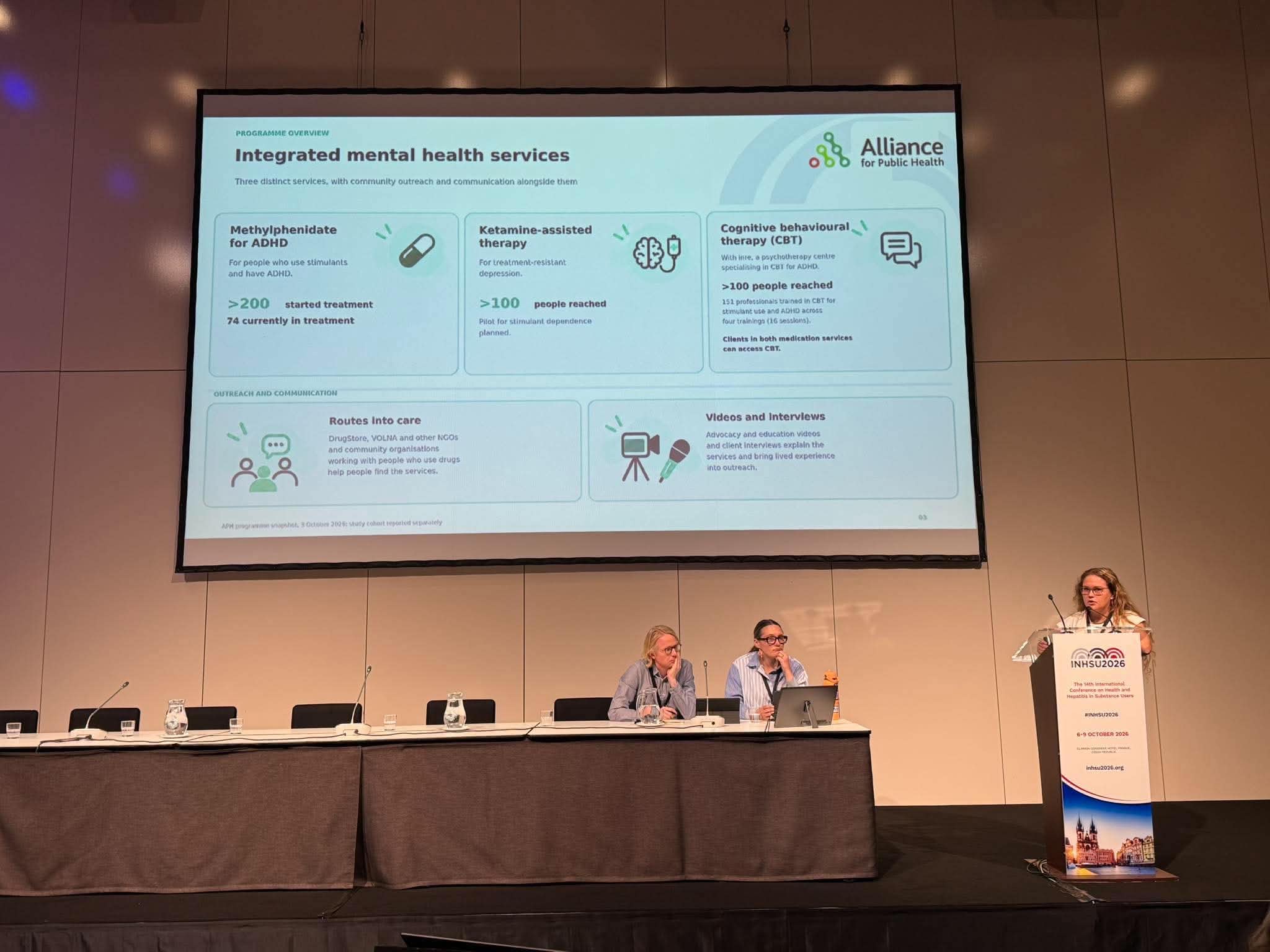
On the final day of INHSU 2026 in Prague, Alliance for Public Health’s Maria Malakhova presented Ukraine’s experience of integrating adult ADHD treatment into services for people who use stimulants. Six-month follow-up data from 41 participants showed lower stimulant-related risk scores, reduced craving and improvements in several areas of quality of life.
For some people who use stimulants, difficulties with attention, restlessness and daily routines may be signs of undiagnosed attention-deficit/hyperactivity disorder (ADHD). These needs can remain unrecognised when services focus only on substance use.
Addressing this gap was the starting point for APH’s pilot. Speaking in the “Integrated Health Responses” session on 9 October, Maria Malakhova, Project Manager for Implementation Science and Digital Health Innovations at APH, presented “Integrating ADHD treatment into stimulant use services in Ukraine: a multi-site operational model of care”.
Care built around people’s needs
APH launched the programme in 2024. Adults with suspected ADHD who use stimulants are referred through trusted community partners, including DrugStore, VOLNA and other organisations working with people who use drugs. Psychiatrists confirm the diagnosis and assess substance use before starting supervised treatment with methylphenidate. Doses are adjusted individually, with regular follow-up and take-home doses when clinically appropriate.
Kyiv service records showed ages ranging from 18 to 58, with a median recorded age of 28 and an almost equal distribution of female and male records. These figures describe the wider service register, which includes repeat admissions, rather than the demographic profile of the 41 participants in the six-month analysis.
According to the programme figures presented by Malakhova, more than 200 people had started ADHD treatment at some point, and 74 were receiving treatment at the time of the conference.
Alongside this work, APH has developed other mental health services. Its ketamine-assisted therapy programme for treatment-resistant depression has reached more than 100 people. APH has also trained 151 mental health professionals in cognitive behavioural therapy (CBT) for stimulant use and ADHD. Through its collaboration with INRE, a CBT centre with expertise in adult ADHD, optional online CBT is available to participants in both the ADHD and depression treatment programmes.
APH is also preparing to launch a pilot study of ketamine-based treatment for stimulant dependence. This is a separate initiative from its existing ketamine-assisted therapy programme for depression.
What changed after six months
The prospective observational evaluation compared baseline and six-month assessments for 41 participants. Scores measuring amphetamine-related problems and craving fell substantially.
The mean amphetamine-type stimulant score on the adapted Alcohol, Smoking and Substance Involvement Screening Test (ASSIST) fell from 9.59 to 2.94. The mean craving score, reflecting the reported frequency of a strong urge to use amphetamines, fell from 2.73 to 0.85. Both changes remained statistically significant after adjustment for multiple testing (adjusted p < 0.001).
No substance category showed a statistically significant increase in its ASSIST score. Quality of life, measured using WHOQOL-BREF, improved significantly in three domains: physical health, psychological health and environment. The change in the social relationships domain was not statistically significant.
These findings have important limits. This was an observational evaluation without a comparison group, so the changes cannot be attributed to methylphenidate alone. Baseline substance-use questions covered the previous three months, while follow-up questions covered the previous month; this difference also needs to be considered when interpreting the results. The findings describe participants who completed both assessments and do not establish outcomes for everyone who entered care.
Alongside the measured outcomes, she described changes in participants’ everyday lives.
Individual client accounts described reduced craving, improved well-being and a return to work. Malakhova also described participants rebuilding relationships with family members. These experiences illustrate what change can mean in everyday life, rather than representing outcomes for all participants.
War also affects continuity of care. Service records described interruptions associated with relocation and military redeployment, alongside missed visits, loss of contact and health difficulties. These descriptive records highlight the need for flexible access and active follow-up; they do not provide a formal retention rate.
A gap beyond the pilot
The presentation also highlighted a broader problem: limited access to ADHD diagnosis and treatment for adults in Ukraine.
Drawing on international research estimating persistent adult ADHD at about 2.6%, Malakhova presented a broad extrapolation of roughly 650,000 to one million adults potentially living with ADHD in Ukraine. This illustrates possible unmet need rather than a measured Ukrainian prevalence. In contrast, an administrative eHealth extract available to the team recorded 625 adults with an F90.0 diagnosis as of December 2024. It also listed 831 methylphenidate electronic prescriptions issued and 525 redeemed across children and adults. These are prescription counts, not numbers of individual patients, and recorded diagnoses do not capture everyone living with ADHD.
Contact with the community of adults living with ADHD helped APH identify barriers beyond stimulant-use services. Malakhova described limited and inconsistent pharmacy availability of methylphenidate, as well as gaps in clinicians’ knowledge and capacity to diagnose and treat adult ADHD. APH is seeking support for ADHD advocacy and access to treatment, alongside capacity building for doctors.
For people who use drugs, access can be more difficult still. Asked by a delegate whether participants must stop using drugs before receiving treatment, Malakhova explained that APH does not make abstinence a condition of care. The programme supports people to reduce or stop their use while addressing their ADHD treatment needs.
Sustaining care and building the evidence
The programme initially operated at seven sites in six cities. At the time of the conference, treatment continued at one site in Kyiv, while requests for support were still arriving from other cities.
The original pilot received Global Fund support through the regional SoS Project 2.0. The ongoing programme receives support from Sida through a partnership with Frontline AIDS. A proposal to include this care in the national grant was not prioritised, leaving sustained financing as a barrier to maintaining and expanding access.
APH is seeking partners and funding to sustain services for people who use stimulants, expand access to ADHD care and strengthen clinical capacity. The team is completing additional analyses and preparing a report, journal paper and public webinar, while seeking opportunities for controlled evaluation.
Further work is also needed to understand whether improvements persist after treatment stops, including among people who discontinue early or pause and restart care.
For APH, the next step is to keep care available while building stronger evidence about what works. Malakhova invited collaboration to sustain stimulant-use services, expand ADHD care and support the ketamine study. “We really hope for some collaboration, support, funding and whatnot to help us move this forward,” she said.