
How can we help people who do not know their HIV status get tested and access the care they need?
Dr Tetiana Deshko, Director of International Programmes and Development at the Alliance for Public Health (APH), shared experience from APH’s programmes in Ukraine and other countries in Eastern Europe and Central Asia (EECA) at a regional workshop on tuberculosis and HIV held on 29–30 September 2026 in Tashkent.
Organised by Médecins Sans Frontières (MSF) in collaboration with WHO and Uzbekistan’s Ministry of Health, the event brought together representatives of national programmes, international experts and civil society. Participants discussed how to accelerate the introduction of new approaches to HIV and TB prevention, diagnosis and treatment across EECA.
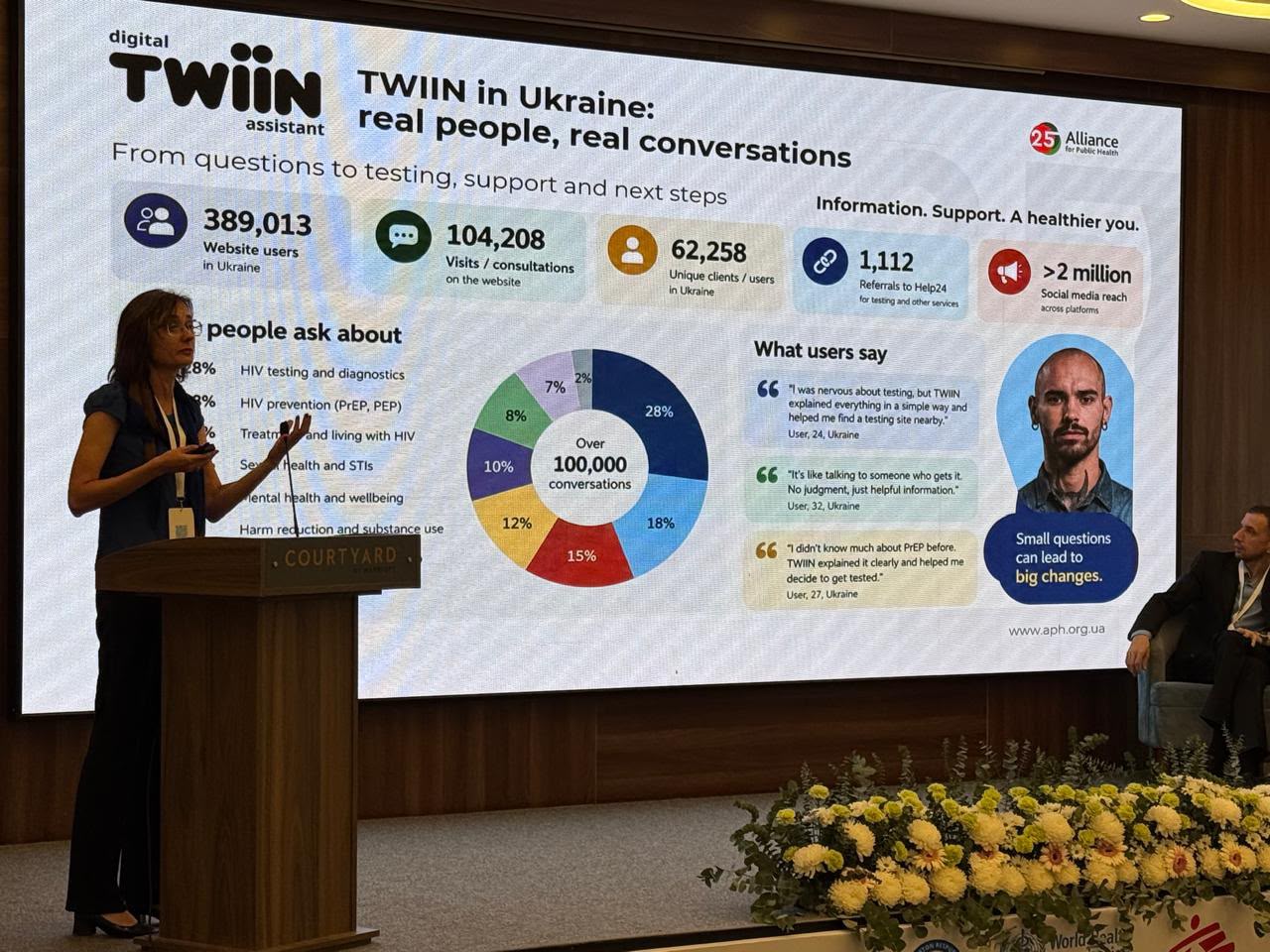
In her presentation, Dr Deshko focused on practical solutions that support more effective and earlier HIV diagnosis and shorten the journey from testing to treatment. These included a diagnostic algorithm using three rapid tests, the work of civil society organisations and mobile teams in optimised HIV case finding, and digital solutions: using artificial intelligence to analyse programme data in DHIS2 and supporting people through the TWIIN digital assistant.
“EECA is the only region globally with growing HIV incidence and AIDS-related mortality, due to lack of prevention and suboptimal HIV care coverage. The WHO consultation gave clear pathways: long-acting pre-exposure prophylaxis (LA PrEP) must become a reality, three rapid tests for HIV should lead to a diagnosis, and HIV case-finding strategies using risk networks, together with AI, should help navigate risks and identify new cases or prevent infections as early as possible. These are exactly the solutions I spoke about,” said Dr Tetiana Deshko.
Three Rapid Tests: Diagnosis in a Single Visit
One example was Ukraine’s HIV diagnostic algorithm, which uses three consecutive rapid tests. When trained staff and the necessary tests are available, and all three tests produce reactive results, the algorithm allows a diagnosis to be established in a single visit. This reduces waiting times and helps people access treatment sooner. Moldova and Georgia shared similar experiences.
Community-Based Testing and Support
Another approach involves reaching people for testing through HIV risk networks. Through APH’s programmes, people newly diagnosed with HIV invite partners and others they know who may be at increased risk of HIV to get tested. This work takes place at fixed testing sites run by NGOs and through mobile clinics.
Mobile teams work in areas where HIV services are limited or unavailable. Following testing, people receive support to start treatment or access prevention services. People who test positive receive coupons to invite others in their networks to get tested.
In the first half of 2026, APH’s optimised HIV case-finding programmes identified 716 new cases – almost a quarter of all new cases registered in the regions where these programmes operate.
DHIS2 and TWIIN: Digital Solutions under the iSoS Project
Dr Tetiana Deshko also highlighted digital solutions under the regional iSoS project, supported by the Global Fund to Fight AIDS, Tuberculosis and Malaria. She presented approaches to using artificial intelligence to support HIV testing programmes in Central Asia, drawing on the use of DHIS2. AI-assisted analysis of programme data helps identify prevention programme clients at the highest risk of HIV and direct teams’ efforts to where testing is most needed.
Another tool presented was the TWIIN digital assistant, which supports people throughout their testing journey – from finding information about HIV and deciding to get tested to understanding their results and the next steps. It helps answer questions and navigate available services, complementing the work of professionals and civil society organisations.
The experience presented highlights the importance of combining accessible diagnosis, civil society engagement and ongoing support. For people using these services, this means being able to learn their HIV status and access treatment, prevention and support without unnecessary barriers.