
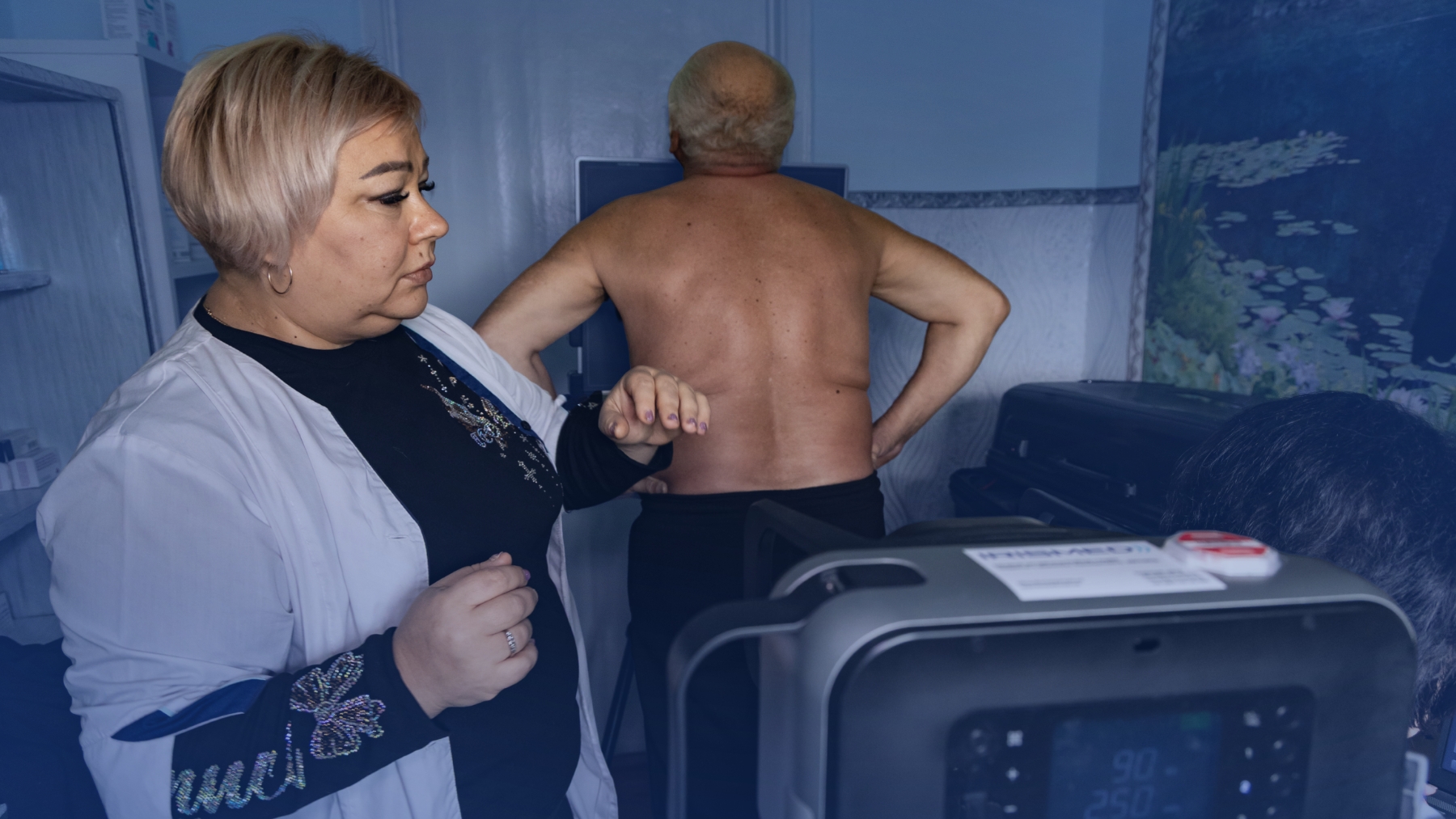
X-ray technician Maria travels to de-occupied and frontline settlements in the Kherson region of Ukraine – places where hospitals are destroyed, pharmacies are closed, transport links are severed, and mobile connection is often unavailable. She is a member of a mobile medical team for a tuberculosis screening project in the Kherson region where the risk of tuberculosis remains one of the highest in the country due to the war, forced displacement, and interrupted treatment.
For Maria, joining this project was no accident. She has worked in medicine her entire life. While workplaces and conditions have changed, her desire to be useful and to learn has remained constant. When she heard about the launch of mobile TB screening in frontline communities, she had no doubts. “I knew it would be difficult there. But if not us, then who?” says Maria. She applied, underwent the necessary training, mastered modern diagnostic equipment, and became part of a team working where the traditional healthcare system is not yet functioning and accessible.
In 2024, the tuberculosis incidence rate in the Kherson region increased approximately 1.5 times. This isn’t surprising given that diagnosis has been delayed by the war. During each trip, suspected cases of TB are identified that would have otherwise gone undetected without screening. Early detection allows treatment to start on time, to prevent severe complications and to receive better treatment outcomes.
At 6:00 AM, Kherson is still in semi-darkness. The air is cold and tense – the way it only feels on the frontier of war. Maria closes her front door, checks her backpack, and gets into the car. Another mission lies ahead.
Just as the team is about to leave the city, an air raid siren cuts through the silence. Alerts appear on their phones, warning of a possible drone attack. The team turns back and takes shelter, following established safety procedures. Only after the all-clear signal do they set off on the road. “You quickly learn to distinguish sounds here – an ‘outgoing’ shot from an ‘incoming’ hit or an interception. Your fear never truly disappears,” Maria admits.
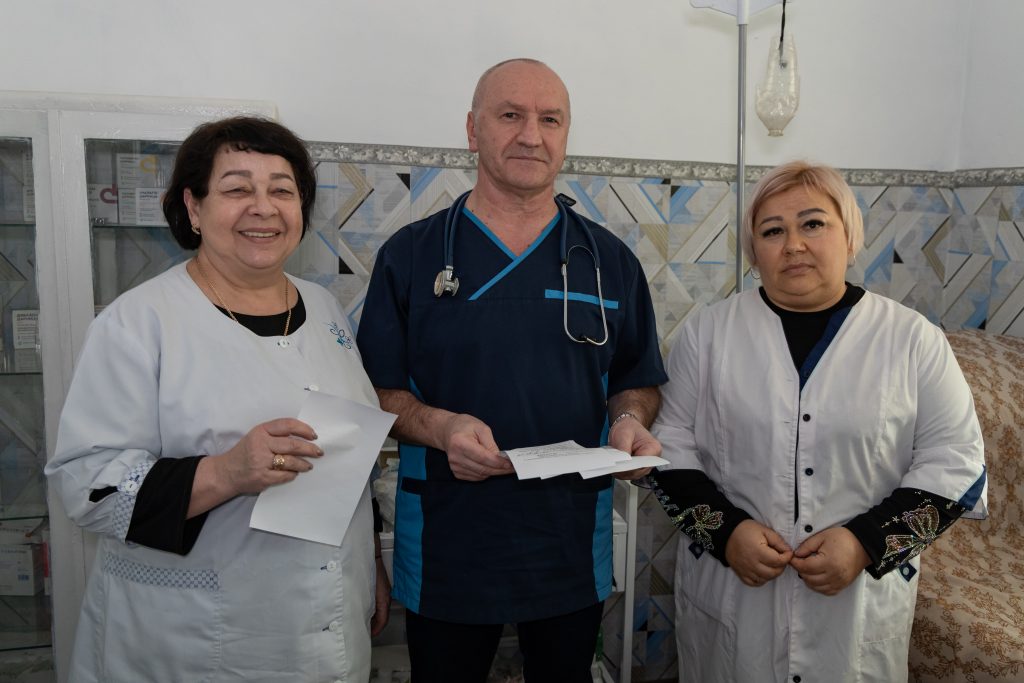
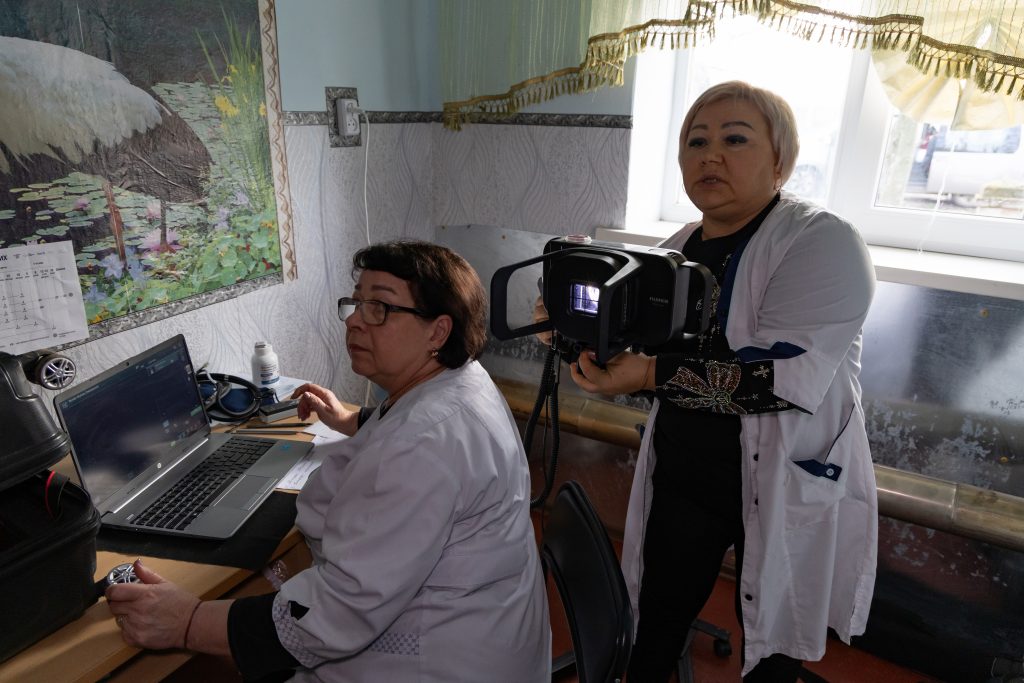
Working alongside her are radiologist Lyubomir and nurse Valentyna. Each of them understands that they need to balance risk and necessity on every trip. In frontline conditions, it is not just the number of patients examined that matters, but also preserving equipment and ensuring the safety of the staff by choosing the right route to avoid becoming a target. They must make constant judgement calls and quick decisions on the go, under the sound of sirens and explosions.
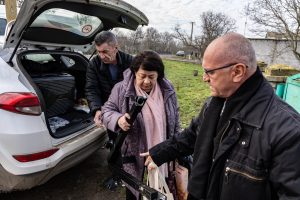
Even a short drive through the Kherson region carries risks. The team navigates carefully, balancing speed and safety to reach people cut off from medical care.
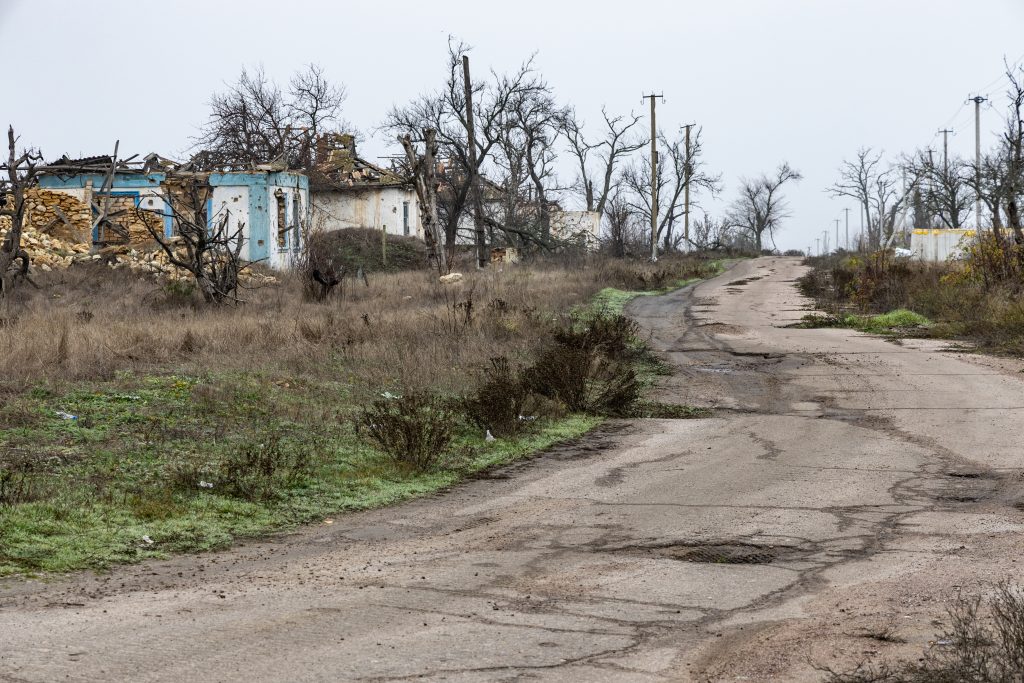
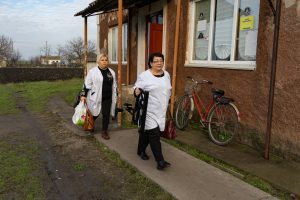
The journey takes over five hours navigating broken roads, missing signs and destroyed bridges. But the specialists reach even the most remote villages – sometimes covering 150–200 km one way. They bring with them not only modern equipment but also a chance for diagnosis and treatment.
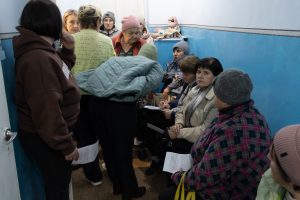
The mobile brigade reached their intended destination around noon. People are already waiting. For many, this is their first medical examination since the start of the war. “We have been waiting for you for a long time,” says an older woman as she enters the room.
In these communities, medicine is provided in nearly impossible circumstances. There is only one paramedic serving several villages. In the Kherson region, these are mostly older paramedics working at the limit of their capacity in the realities of war and without full medical support. In winter, the centers are unheated. There is no electricity, and in some places, not even water. In such conditions, regular check-ups or early diagnostics are effectively a luxury. That is why the arrival of the medical team is more than a service. It is their lifeline, an opportunity to save health and even lives.
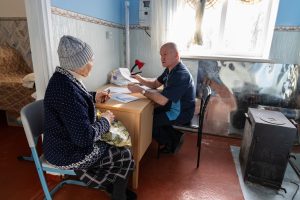
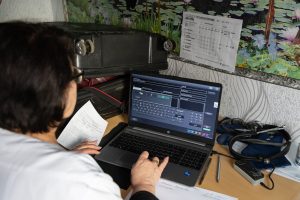
The portable X-ray is set up. The reception begins. Every patient is interviewed, examined. The images are analyzed in Kherson. In case of suspected tuberculosis, people are referred for further in-depth medical examination.
- Over five hundred people pass through the mobile screening clinic in the Kherson region every month for many, it is the first medical examination after the war started. Without such trips, these communities would remain outside the healthcare system.
- In the second half year of 2025, the mobile team systematically covered 37 settlements in 17 rural communities, conducting X-ray screening for 1,771 people. 22 sputum tests using GeneXpert were performed, 12 patients were referred for further examination with suspected tuberculosis, and 1 case of active TB was confirmed.
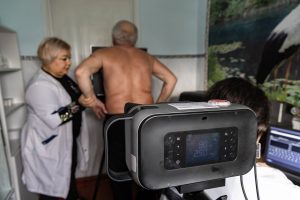
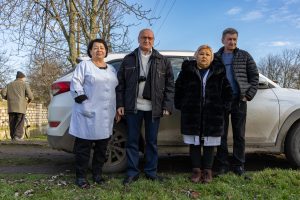
These people are residents of frontline communities whose regular access to medicine was interrupted by the war. They are mostly pensioners and people with limited mobility.
Mykola, 75, local resident, pensioner Mykola is among the first to arrive. He says he heard about the medics’ arrival from the village head. The last time he saw a doctor was before the full-scale invasion when the district hospital was still operating. Then came occupation, shelling, and destroyed roads. He has neither the strength nor the desire to travel anywhere. For him, this examination is a chance to check on his health.
Olena, 36, displaced person Olena has lived in the village for two years with her two children – she fled another district of Kherson after shelling. She feels fine but decided to get checked “for peace of mind.” She says she is most afraid not of the disease, but of not being able to get treatment if she falls ill. Maria explains how aid is provided under this project, reassures her, and says that no one will be left alone with a diagnosis. After the examination, Olena exhales: “At least now I know everything is in order.”
Petro, 62, local resident, working on house restoration Petro is a pensioner but still works on clearing rubble and repairing houses after shelling. He says he is constantly working in dust and in the cold, often without proper nutrition. He knows little about tuberculosis but heard that the disease “likes such conditions.” He doesn’t panic but takes it seriously: “If there is something, it’s better to know now.” For him, the arrival of the mobile brigade is an opportunity to undergo TB screening without traveling to Kherson.
Towards evening, the team sets off back to Kherson. Ahead is darkness, a road without lights, and another five-hour journey. Maria is tired but calm. “It’s not extraordinary. It’s just work that someone has to do,” she says.
The mobile tuberculosis screening project in the Kherson region is implemented by the ICF “Alliance for Public Health” in partnership with the Phthisiopulmonology Medical Center of the Kherson Regional Council, with the support of Frontline AIDS and financial support by SIDA.
Every X-ray image is not just an examination, but a chance to break the chain of tuberculosis transmission in communities where treatment has been interrupted by war, displacement, and a lack of access to medicine. It is thanks to international support and partnerships that such mobile teams can work regularly rather than occasionally to maintain continuity of care, even in frontline regions.
“Thank you for coming,” a woman says as she leaves, holding Maria’s hand tightly. This phrase captures the entire essence of frontline medicine. Where war has destroyed hospitals and aid routes, people are still waiting. And someone must reach them with vital equipment, knowledge, and life-saving medicine to stop the spread of tuberculosis during the war.
Photo: Oleksandr Andryushchenko