
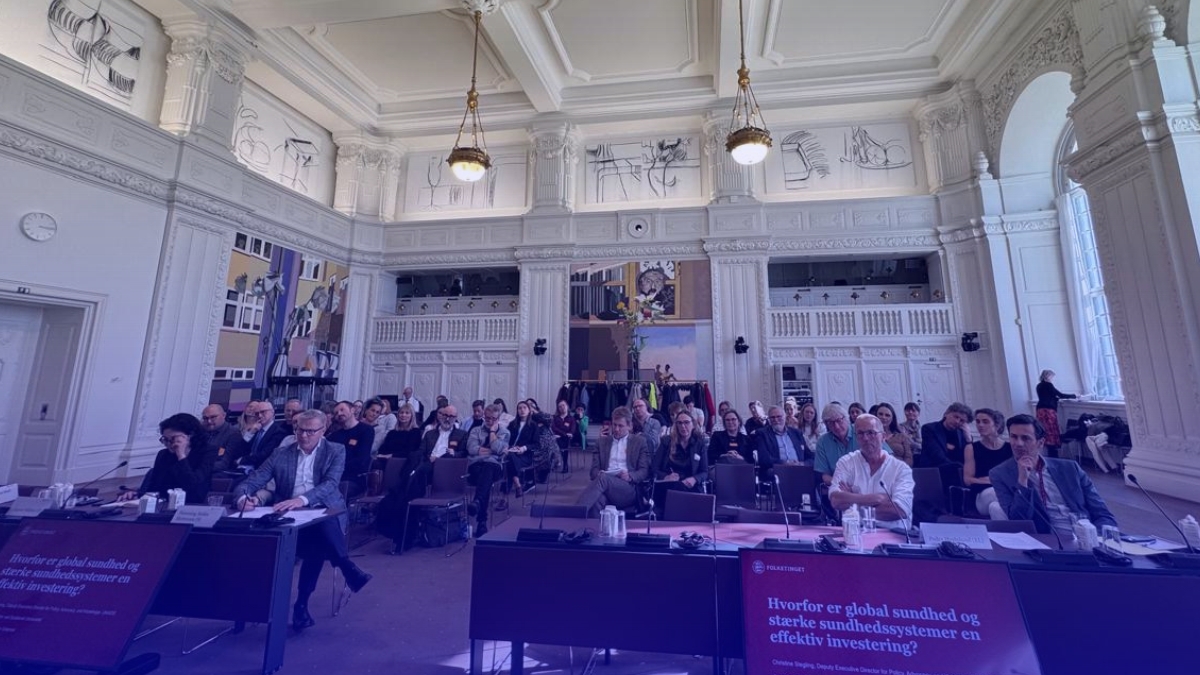
On April 1, Executive Director of the Alliance for Public Health Andriy Klepikov presented a unique example in the Danish Parliament: how, despite the full-scale war, we manage to contain the spread of HIV and tuberculosis. He expressed gratitude to Prime Minister Mette Frederiksen, all members of Parliament, and all Danish people for incredible support to Ukraine.
“Nowadays security is getting top priority on the European agenda. Although it shouldn’t be a choice between security and health, either or. It is a false dilemma. Health is also security. Socially dangerous diseases has no borders,” Klepikov emphasized.
The strength of the Ukrainian response lies in partnership: civil society, communities, the medical system, the government, and international donors. In particular, the Global Fund, which adapted programs and provided emergency funding in the first days of the war.
Key elements of the successful response included: a focus on key population groups, deployment of more than 40 mobile clinics in 320 remote locations near the combat zone, and the implementation of digital solutions such as a virtual social worker and telemedicine. The HelpNow service provided more than 40,000 consultations in 52 countries.
“If a person is starving, I can’t say: sorry, I only have a condom. I must find them food,” Klepikov emphasized, highlighting the importance of combining medical services with humanitarian aid in wartime conditions.
Klepikov also called for support for the Global Fund’s eighth replenishment and not to reduce the volume of international aid.
You can learn more about the Eighth Replenishment Investment Case here.
He also drew attention to the growing role of the European Union in global public health. It is worth noting that from March 18 to 20, 2025, a photo exhibition co-organized by APH took place in the European Parliament, highlighting results of EU investments in the Global Fund and GAVI. The exhibition was supported by the President of the European Parliament Roberta Metsola who spoke at the opening.
Special thanks to Aidsfondet for the invitation, partnership, and support in making this important conversation happen.
We would like to note that the main focus of the meeting was on continuing Denmark’s important role in the global response to the HIV/AIDS, tuberculosis, and malaria epidemics.
The discussion also involved Maureen Murenga (Lean on Me), Christine Stegling (UNAIDS), Angela Chang (Syddansk Universitet – University of Southern Denmark), Tess Hewitt (Médecins Sans Frontières / MSF), and Peter Sands (The Global Fund).
The organizers of the meeting were: Aidsfondet, Médecins Sans Frontières, and the SRHR network of the Danish Parliament: Flemming Møller Mortensen, Peder Hvelplund, and Gunvor Wibroe.